
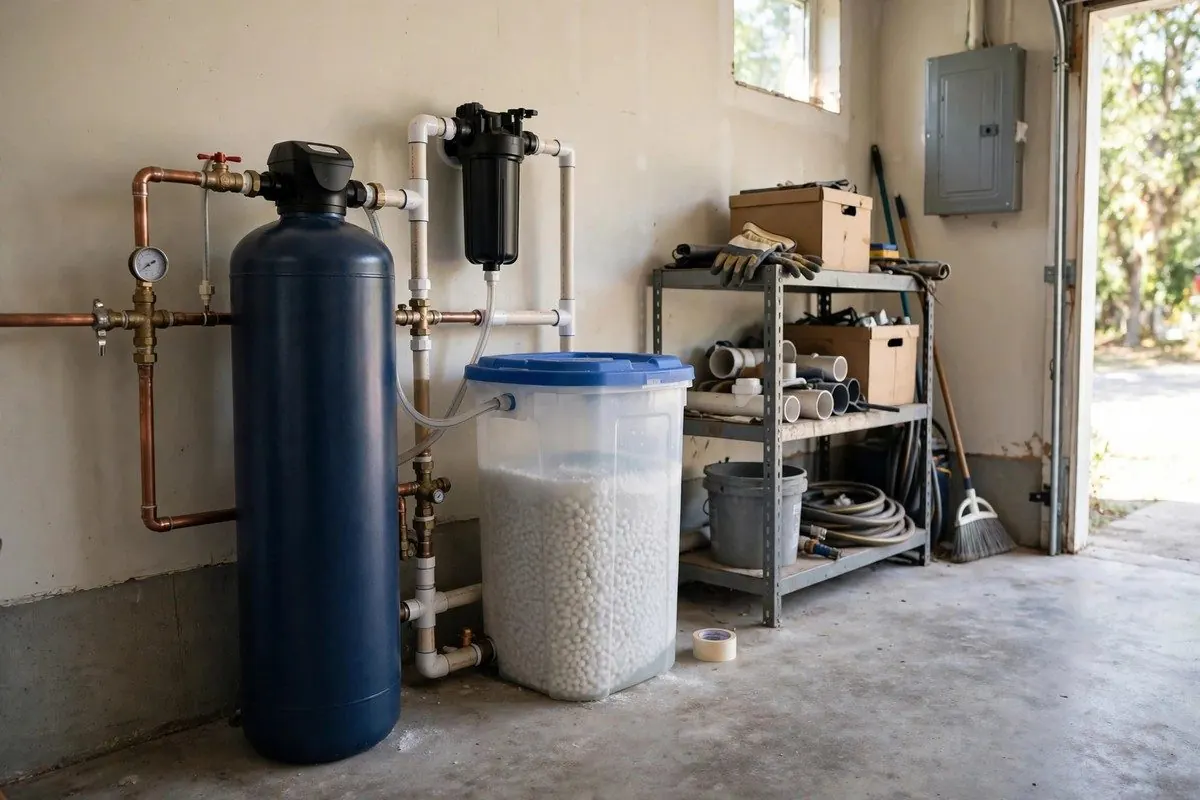
Water Softener Installation in Hanover Park, IL
Scale on faucets, spots on glass and a water heater that works too hard are signs of hard water. A softener installed correctly fixes the cause.
Why Hanover Park homes have hard water
Hanover Park gets 100% Lake Michigan water through the Northwest Suburban Municipal Joint Action Water Agency, and Chicago treats it. The village reports do not list a hardness figure. Reports for the same Chicago supply, such as Streamwood's 2023 report, give about 8 grains per gallon, or 128 to 144 mg/L as calcium carbonate.
That counts as moderately hard on common scales, where hardness above about 7 grains per gallon is called hard. In practice, you will see white crust on faucets, cloudy glasses from the dishwasher, and soap that does not lather well. Inside, scale builds on heating elements and shortens appliance life.
| Where | What you see | What is happening |
|---|---|---|
| Faucets and showerheads | White crust, weak spray | Calcium and magnesium deposit as water evaporates |
| Water heater | Popping noises, slower recovery | Scale settles under the burner or element |
| Dishes and glass | Spots and film | Minerals left behind after drying |
| Laundry | Stiff, dull fabric | Soap reacts with minerals and leaves residue |
| Pipes | Narrowing and slower flow | Mineral layers build inside the pipe |
Scale on a tank-type heater is a reason many people call about water heater repair sooner than expected. A softener reduces that wear.
Call and we can test your water hardness, talk through sizing, and plan the installation.
How a softener works
A salt-based softener holds a bed of resin beads charged with sodium. As hard water flows through, calcium and magnesium stick to the beads and sodium goes into the water. When the beads fill up, the unit flushes them with a brine solution and sends the minerals down the drain. This cycle is called regeneration.
Some systems regenerate on a timer. Better ones regenerate by demand, based on how much water has passed through. Demand-initiated units usually waste less salt and water, which is why we lean toward them for households with changing usage.
What the installation involves
Test the water
We measure hardness so the unit is sized to the real number, not a guess.
Pick the spot
The softener goes on the main supply, after the meter and before the water heater, near a floor drain or standpipe and a power outlet.
Add bypass and shutoffs
A bypass valve lets you isolate the softener for service without cutting water to the house.
Connect the drain line
The regeneration discharge must leave through an air gap so wastewater cannot siphon back into the unit.
Set the controls
We program hardness, capacity and regeneration time, then run a test cycle and check for leaks.
We keep outside hose bibs on hard water. Lawns and gardens do not need softened water, and softening them wastes salt. Kitchen cold taps are a personal choice, since softened water adds a little sodium.
Sizing and settings
Softener capacity is measured in grains. To size one, multiply the number of people by about 75 gallons of daily use, then by your hardness in grains per gallon. That gives the grains removed per day, and the unit should hold several days of that before it regenerates.
Too small a unit regenerates constantly and wears out. Too large a unit sits idle and the resin can foul. We choose a size that regenerates about once a week for an average household and set the salt dose to match.
Drain, code and the village sewer
The Illinois Plumbing Code governs how the softener connects to the supply and the drain. The discharge must be indirect, with an air gap, so that sewage or drain water cannot be drawn back. Backflow protection on the supply is also part of the code.
Discharge goes to a floor drain, laundry standpipe or sump, depending on the home. Hanover Park has more than 200 miles of storm and sanitary sewers, and the softener drain should go to the sanitary side, not the storm system. If you also have a sump pit, keep softener discharge separate from it, and see sump pump repair if you have flooding issues in that basement.
Softeners in Hanover Park homes
Many homes in Hanover Park date to the 1960s and 1970s, in neighborhoods like Greenbrook, Woodlake Trails and Olde Salem. Older galvanized and copper pipe can trap scale from hard water, and softener installation is often the best time to look at the pipe. If supply lines are badly corroded, repiping before or with the softener helps the whole system.
A softener does not make water free of everything. It does not remove lead or filter drinking water. If your service line contains lead, check the village's service line inventory and talk to us about the line, not just the softener.
What affects the cost of installing a water softener
The unit is only part of the job. These are the factors that shape the total.
Unit size and type
Capacity, demand-based controls and dual-tank models differ in price.
Hardness and household size
Bigger families and harder water need more capacity.
Distance to drain and power
A unit next to a floor drain is simple. A long drain run or no nearby outlet adds work.
Existing plumbing
Corroded or galvanized pipe at the connection point may need replacing.
Permits
Some installations may need a village permit, which we confirm with Inspectional Services.
A softener is a home improvement and is generally not covered by insurance. Ongoing costs include salt and a small amount of water for regeneration.
Call and we will test your water, size the unit, and explain the cost factors before we begin.
Water source and softener rules in Hanover Park
The village obtains 100% Lake Michigan water through the Northwest Suburban Municipal Joint Action Water Agency, and wells are emergency backup only. Hanover Park Public Works runs the water system, which has 122.1 miles of water mains and 10,826 metered customers.
For you, the practical point is that supply is consistent from year to year, so a softener set to your tested hardness stays well matched. Ask Public Works if you want the village's most recent water quality report.
Source type: Hanover Park Public Works water supply information
Codes and standards that apply
Softener plumbing, including the drain connection and bypass, follows the Illinois Plumbing Code (77 Ill. Adm. Code 890). The backflow rules in that code are why the drain line needs an air gap.
Common questions
Hanover Park buys Lake Michigan water treated by Chicago. The village reports do not list hardness. Reports for the same supply, such as Streamwood's 2023 report, give about 8 grains per gallon, which is moderately hard.
It depends on the scope. Connecting to supply and drain lines can count as plumbing work. We check with Inspectional Services and file the permit where it is required.
To a floor drain, laundry standpipe or sump, through an air gap. It must go to the sanitary side, not the storm sewer. We pick the closest code-compliant spot.
It depends on hardness, household size and the unit's efficiency. Demand-initiated units use less than timer-based ones. Most homes refill the brine tank every month or two.
Softened water contains a small amount of added sodium, but most people do not notice it. Some install a separate tap for drinking water if they want to avoid it.
It reduces scale on heating elements and tank bottoms, which can extend life. It does not replace flushing the tank. See our water heater installation page for how scale affects heaters.
No. A softener targets calcium and magnesium. If your service line contains lead, the village inventory and the line itself matter more. Ask us about testing and line replacement.
Stop the scale at the source
Call our Hanover Park plumbers to size and install a water softener for your home.