
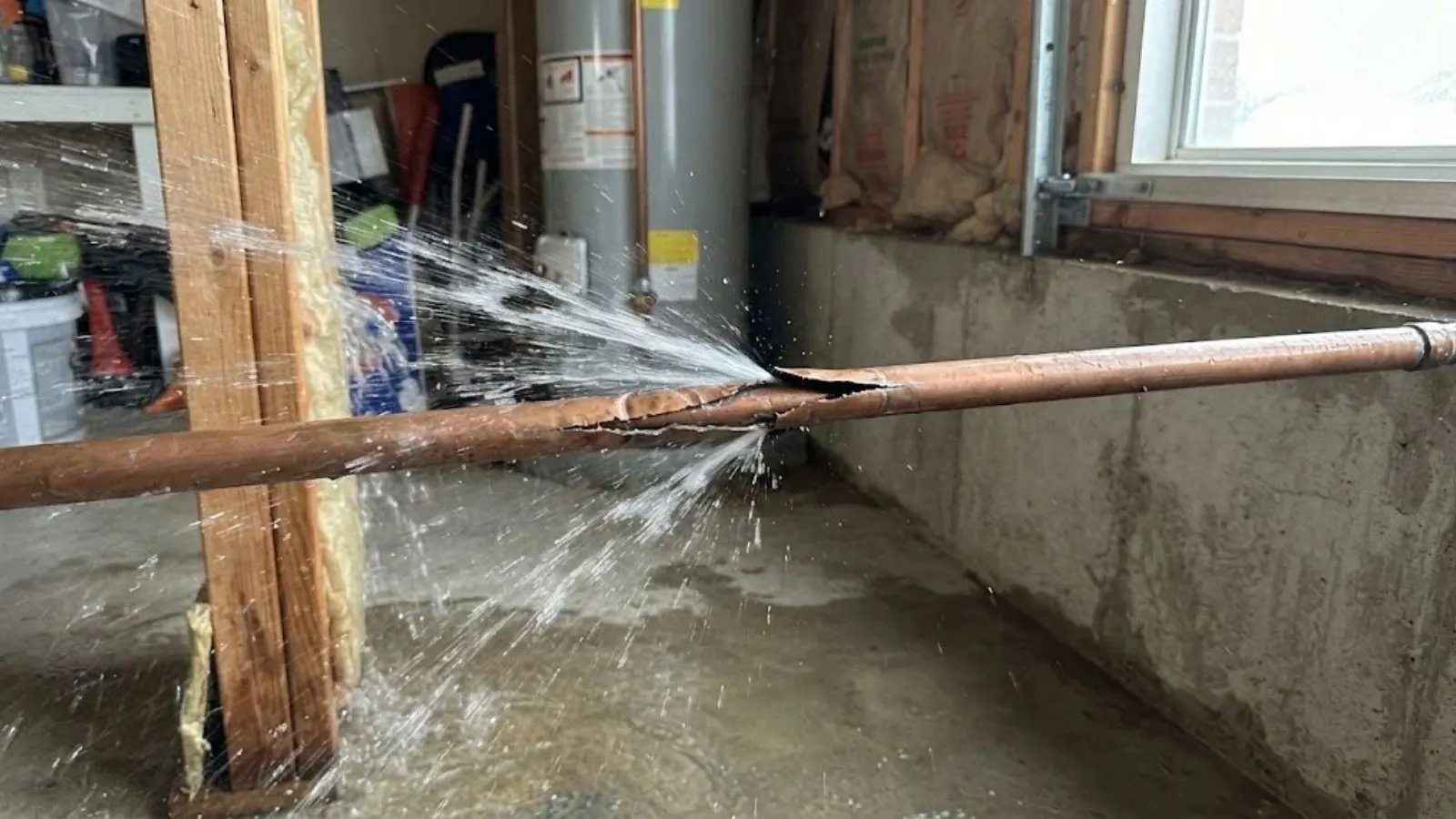
Emergency Burst Pipe Repair in Hanover Park, IL
Water is pouring from a pipe. Close the main shutoff, open a faucet low in the house, then call. We will stop the damage and replace the broken section.
What to do right now
- Find the main shutoff, usually near the water meter, and turn the handle clockwise until it stops.
- Open a cold tap at the lowest level of the house to drain remaining water from the pipes.
- Switch off power to any wet area if you can reach the panel without stepping in water.
- Turn off the water heater so it does not run dry and overheat.
- Move belongings, lift rugs and photograph the damage for your insurer.
- Call us. Do not wait for the water to stop dripping.
If the main shutoff will not turn, call right away and tell us. Old gate valves seize with age. We carry the tools to close the line at the meter or curb stop when the house valve fails.
Water near electrical
If water is reaching outlets, the panel or a ceiling light fixture, stay out of the room. Cut power from the breaker only if the panel is dry and away from the water. Otherwise call us and your electric utility.
Why pipes burst
A pipe bursts when pressure inside outruns what the metal or plastic can hold. The most common cause in northern Illinois is freezing. Water expands as it turns to ice, and the pressure builds between the ice plug and the closed faucet. The split usually forms in the pipe wall, not where the ice sits.
Age is the second cause. Galvanized steel corrodes from the inside and thins out. Copper can pit, and soldered joints weaken. Add a pressure spike from a closing valve, called water hammer, and a tired section gives way. Both causes show up in homes built in the 1960s and 1970s.
| Cause | Warning sign beforehand | Where it tends to burst |
|---|---|---|
| Frozen pipe | Faucet gives a trickle or nothing in a deep freeze | Exterior walls, garage, crawl space |
| Corrosion in galvanized steel | Brown water, falling pressure | Elbows, threaded joints, old branch lines |
| Pitted or aged copper | Green stains, pinhole drips | Soldered joints and thin spots |
| Water hammer | Banging when valves close | Weak fittings near fast-closing valves |
| High water pressure | Hissing faucets, running toilets | Whatever section is weakest |
Call now. We answer around the clock and can talk you through the shutoff while a plumber heads your way.
Frozen pipes: thaw safely or wait for us
If a pipe has frozen but not burst, you may be able to prevent a split. Open the faucet so melting ice has a place to go. Warm the pipe slowly with a hair dryer on a low setting, starting near the faucet and working back toward the frozen section.
Never use a torch or open flame. It can ignite framing and damage joints. If you see a bulge, a crack or water where there was none, treat it as a burst and shut off the main. Hanover Park has seen single-digit lows, including in the winter storm of December 2010, so unheated garages and exterior walls deserve attention every January.
How we repair a burst pipe
Stop the water
We confirm the main is closed, drain the lines and make the work area safe.
Find the full damage
A split rarely stands alone. We check nearby sections for bulges or hairline cracks, since a pipe that froze once often froze along its length.
Cut out the bad section
We remove the damaged length back to sound pipe, not just the visible split.
Replace with the right material
Copper, PEX or another approved pipe is joined with fittings suited to the existing line. Transitions between metals use proper couplings to avoid corrosion.
Pressure test and restore
We turn the water on slowly, check every joint, and run the system under pressure before we call it done.
Where a whole line is old and thin, patching one burst invites the next one. In those cases we talk through repiping the affected run. If a leak is slow and hidden rather than sudden, our leak detection work comes first.
Cleaning up after the water stops
Stopping the water is only half the job. Standing water soaks into drywall, insulation and subfloor, and mold can start within a couple of days. Pull up wet rugs, run fans and a dehumidifier, and remove wet insulation as soon as it is safe.
We do the plumbing repair and can tell you which materials look salvageable. Water mitigation and drywall work are usually done by a restoration contractor, and your insurer may have preferred companies. Keep every receipt and photo.
Burst pipes in Hanover Park homes
Much of the village was built during the 1960s boom, with Greenbrook first and Woodlake Trails and Olde Salem in the early 1970s. Homes from those years often have original copper or galvanized branch lines. Those lines have had fifty years of freeze cycles and mineral wear, so older sections are the likeliest to fail.
The village delivers Lake Michigan water through the Northwest Suburban Municipal Joint Action Water Agency. Reports for the same Chicago supply describe moderately hard water, which leaves scale inside pipes over time. Scale narrows the pipe, raises friction, and can hide corrosion. A softener helps in some homes, see water softener installation.
If water is surfacing in the street or at the curb, the break may be on the village main or on your service line. Public Works handles the main. For a break on your private side, read about water line repair.
What affects the cost of burst pipe repair
Every burst is different. These are the factors that change the scope of the work.
Location of the break
An exposed basement pipe is fast. A break inside a finished wall or under a slab means more access work.
Length of damaged pipe
A single split is a short repair. A frozen run may need several feet or an entire branch replaced.
Pipe material
Copper, PEX and galvanized steel each need different fittings, and converting from old steel adds parts.
Time of day and urgency
After-hours emergency visits take a technician away from rest and are scheduled around a live flood.
Permits and inspection
Replacing larger sections may need a village permit and an inspection through Inspectional Services.
Homeowners insurance policies typically cover sudden water damage, such as a burst pipe, but not damage from wear, corrosion or long-term seepage. Call your insurer early and keep photos of the failed pipe.
We will explain the likely scope and cost factors on arrival, before any work starts.
Preventing the next burst
- Insulate pipes in garages, crawl spaces and exterior walls before November
- Disconnect garden hoses and close the shutoff to outside spigots
- Keep the thermostat at 55 or higher when you are away in winter
- Open cabinet doors on exterior walls during hard freezes
- Know where your main shutoff is and test it twice a year
- Have a plumber check pressure if faucets hiss or toilets run on
A pressure gauge on an outdoor spigot takes seconds and shows whether house pressure is too high. Pressure above about 80 psi strains every fitting in the system, according to common plumbing guidance. A pressure reducing valve is a modest part that protects the rest.
Permits and licensed work in Hanover Park
Plumbing permits in the village are handled by the Inspectional Services Division on Lake Street. Contractors must be registered with the village, with IDPH 055 contractor registration and a 058 plumber licence, before a permit is issued. The Illinois Plumbing Code is 77 Ill. Adm. Code 890.
In practice, a major pipe replacement after a burst should come with a permit and an inspection. Ask your plumber who is pulling it, and confirm their licence on the IDPH online verification tool.
Source type: Hanover Park Inspectional Services and Illinois IDPH
Codes and standards that apply
Supply pipe repairs fall under the Illinois Plumbing Code (77 Ill. Adm. Code 890). Document the damage with photographs before cleanup, because homeowners policies often cover sudden water damage but not wear or slow leaks.
Common questions
Yes. Shut off the main first, open a low tap, and call. We answer around the clock, including weekends and holidays.
Keep the phone nearby so we can walk you through the shutoff if the valve is stiff.
Usually near the water meter, where the line enters the house. In many local homes that is the basement or a utility closet. Turn it clockwise. If you have never found it, locate it this week and tag it.
You can try gentle warmth from a hair dryer with the faucet open. Never use a torch. If the pipe is bulging, cracked or leaking, close the main and call us instead.
Policies typically cover sudden water damage such as a burst pipe, but not damage from wear or slow seepage. Coverage varies, so call your insurer and keep photos and receipts.
We cut back to sound pipe and repair that section. If the rest of the run is corroded or brittle, we explain that and discuss replacing more so you do not face a second burst.
A small repair may not need one. Replacing larger runs often does, and the permit comes from Inspectional Services. We handle that paperwork when the job calls for it.
Not directly. Scale narrows pipes and can hide corrosion, and reports for the same Chicago supply describe moderately hard water. Freezing and pressure spikes are the usual triggers.
Stop the water, then call us
Our plumbers answer around the clock in Hanover Park. Call as soon as the main is closed.