
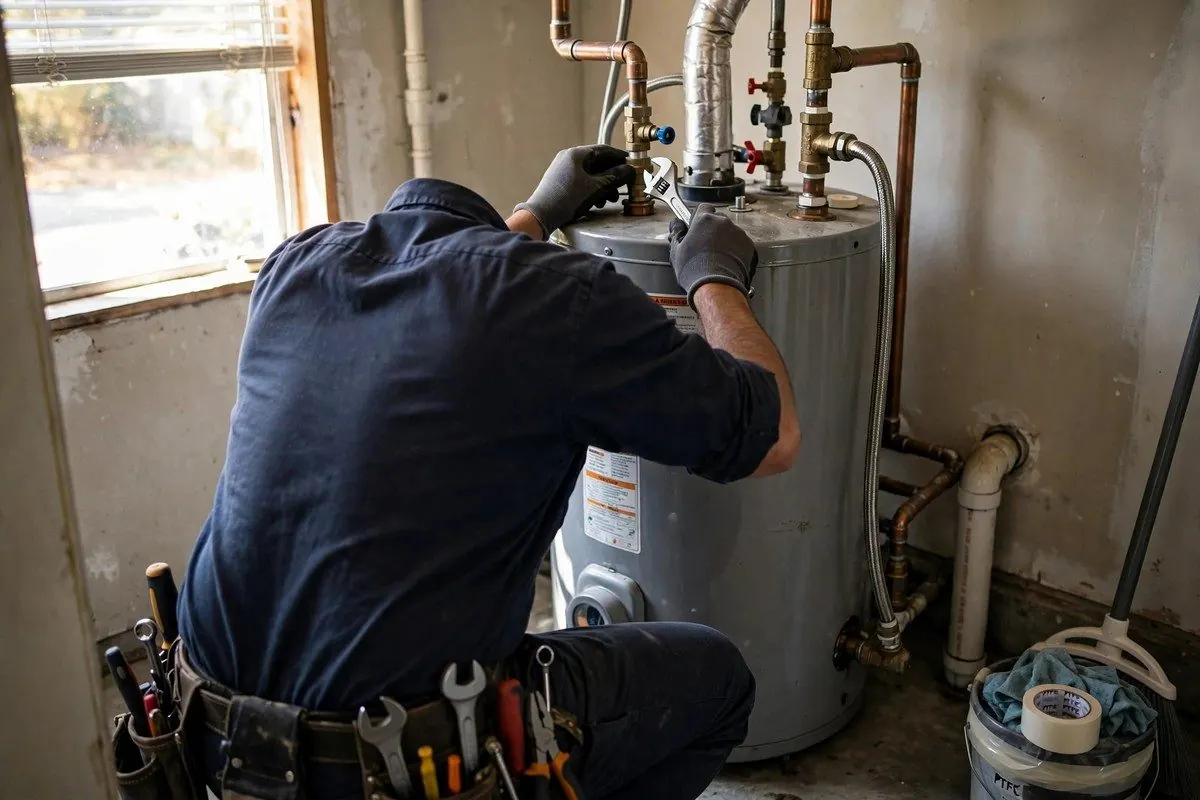
Emergency Water Heater Repair in Hanover Park, IL
If your water heater is leaking, smells like gas, or has gone cold, call now. We diagnose gas and electric tank units around the clock.
What to do right now
A water heater problem can turn into a flooded basement or a gas hazard fast, so the first few minutes matter. Work through these steps while you call us, and keep everyone away from the unit if anything looks unsafe.
Smell gas? Leave first
If you smell gas or rotten eggs near a gas unit, do not flip switches or light anything. Walk outside and call the gas utility's emergency line, then call us.
Stop the water feeding the tank
Find the cold water shutoff valve on the pipe entering the top of the heater. Turn the handle clockwise until it stops. A leaking tank then stops refilling.
Kill the power or the gas
For electric units, switch off the dedicated breaker. For gas units, turn the gas control knob to OFF or the pilot setting. Never leave a leaking electric heater energized.
Protect the floor
Move boxes, laundry, and electronics away from the water. Set a bucket under any steady drip and a wet vacuum nearby if the floor drain is far away.
Note what you see
Write down any error light blinks, the tank label's model number, and where the water is coming from. That saves diagnostic time when the technician arrives.
Do not touch scalding or sparking parts
Steam from the relief valve, a hot tank shell, or scorched wiring near the heater are warning signs. Stay back, shut off power at the panel if you can reach it dry, and call us.
Why water heaters fail in Hanover Park homes
Hanover Park grew fast in the 1960s and 1970s, and many homes here have utility rooms, basements, or crawl-space closets built around an older tank layout. The original heaters are long gone, but the gas lines, flues, and cold-water piping behind them are often decades old. A repair call frequently turns up a corroded shutoff valve or a flue that was patched years ago.
The village gets 100% Lake Michigan water through the Northwest Suburban Municipal Joint Action Water Agency. The village's own reports list no hardness figure, but the Streamwood 2023 report for the same Chicago supply cites 8 grains per gallon, which is moderately hard water. That means minerals settle at the bottom of a tank over the years, so sediment is one of the first things we check on an aging heater.
Problems we diagnose and fix
No hot water at all
On a gas unit the cause is usually a pilot that will not stay lit, a worn thermocouple, or a failed gas control valve. On electric units we test the high-limit reset, the thermostats, and the heating elements.
Lukewarm or running out fast
A burned-out lower element, a broken dip tube, or heavy sediment can all shorten your hot water. A dip tube that cracks sends cold water straight to the top of the tank, which drops outlet temperature.
Rumbling, popping, or knocking
Water trapped under a layer of hardened sediment boils and bursts through it. The noise tells us the tank is working harder than it should. A flush often helps if the tank is still sound.
Water around the base
The leak may be a loose fitting, a weeping relief valve, or a rusted tank. Fittings and valves can be repaired. A tank that leaks through its shell cannot.
Rust-colored hot water
If only the hot side runs brown, the tank interior or a spent anode rod is the usual suspect. Cold water that also runs brown points to the supply piping instead.
Rotten egg smell from hot water
Bacteria can react with the magnesium anode rod and produce sulfur odor. Swapping to a different anode and flushing the tank often clears it up.
| Symptom | Likely cause | Typical repair |
|---|---|---|
| Pilot keeps going out | Dirty pilot tube, weak thermocouple, or drafty flue | Clean or replace thermocouple, check flue draft |
| No heat on electric unit | Tripped high-limit, bad thermostat, or failed element | Reset and test, then replace failed part |
| Water drips from relief valve pipe | Thermal expansion pressure or a worn valve seat | Test valve, check thermal expansion control |
| Popping or rumbling | Hardened sediment on tank bottom | Flush tank, evaluate tank condition |
| Puddle under tank | Loose fitting, bad drain valve, or failed tank | Tighten or replace part, or plan a replacement |
| Fluctuating temperature | Failing thermostat or gas valve | Test controls and replace what failed |
Call and a licensed technician will walk through your symptoms and head to Hanover Park.
How a gas tank heater is diagnosed
Gas heaters rely on a flame, a safety sensor, and a controlled flue path. We start by checking that the flame is a steady blue and that the burner is clean. A yellow or lazy flame points to poor combustion air or a dirty burner tray, both of which can also raise carbon monoxide risk.
Next we confirm the thermocouple or flame sensor is producing a signal strong enough to hold the gas valve open. A weak sensor is a cheap part, but it is the number one reason a pilot keeps dying. Then we look at the flue, because a loose or backpitched vent can spill exhaust into the room instead of carrying it outside.
Venting checks matter on older flues
Flue piping should be sealed at each joint and pitched upward toward the chimney or vent. Another Illinois village's permit conditions for water heater work call for three screws per joint and proper pitch to avoid improper drafting. We apply the same standard, because a flue that spills exhaust is a safety issue, not just a repair detail.
How an electric tank heater is diagnosed
Electric units have two heating elements, each with its own thermostat, and a high-limit safety switch near the top. If the upper element or its thermostat fails, you often get no hot water at all. If only the lower element fails, you get a small amount of hot water that runs out quickly.
We use a meter to test continuity on the elements and verify voltage at the terminals, with the power off before any panel is opened. Many elements fail from mineral scale that insulates them, which is another reason hard water shows up in repair work. Replacing an element is far less work than replacing the tank, so it is worth testing before anyone suggests a new heater.
Temperature and pressure relief valve problems
The temperature and pressure relief valve is the last safety device on the tank. If it drips, the water is either too hot, the pressure is too high, or the valve itself is worn. We test the valve by lifting its lever briefly and watching that water flows out and stops cleanly. A valve that keeps dripping after that needs replacement.
Constant dripping can also come from thermal expansion. When a closed plumbing system heats water, the extra volume has nowhere to go, and pressure spikes. In many homes with a backflow device or pressure-reducing valve on the main, an expansion tank is the fix. Another Illinois village states that an expansion tank is required on closed systems, and we check for one on every heater call.
Relief discharge pipes should be rigid metal that terminates where hot water cannot hurt anyone, not capped or reduced. A plugged discharge pipe defeats the whole safety device, so we fix it if we find one.
Repair or replace: how we help you decide
Most tank heaters last about 8 to 12 years, though this depends on the water and how often the tank is flushed. If your unit is within that age range and the tank itself is leaking, repair rarely makes sense. A leaking shell means corrosion has gone through the steel, and no part swap fixes that.
If the tank is sound and the failure is a thermostat, element, thermocouple, or valve, repair is usually the practical choice. When a unit is old, rusted, and needs a part, we tell you plainly and explain the option. If replacement looks right, our water heater replacement page explains how sizing, venting, and permits work. For a new location, see water heater installation.
Some homeowners also ask about moving to a tankless unit after a repair visit. That is a bigger decision involving gas line size and venting, so we cover it separately under tankless water heater service. A repair visit does not commit you to anything.
What affects water heater repair cost
Repair cost varies because no two failures are the same. Here is what shapes the final number once we have diagnosed the unit.
The failed part
A thermocouple, thermostat, element, or relief valve each carries a different parts cost. Gas control valves are usually the most involved single component.
Fuel type and unit age
Parts for gas and electric units differ, and older models may need special-order components. Some older units are not worth putting a part into.
Access and location
A heater in an open utility room is quicker to service than one wedged in a closet or a tight crawl space.
Related fixes found
Corroded shutoff valves, bad flue sections, or a missing expansion tank sometimes turn up during the visit. We explain each before doing it.
After-hours dispatch
Night and weekend calls carry a different rate than a daytime appointment because the technician is called out of normal hours.
Water heater failures from age and wear are generally not covered by homeowners insurance, though sudden water damage from a burst tank may be, depending on your policy.
Call us and we will explain the price before any work begins.
Permits and code in Hanover Park
Repairs that swap a part usually do not need a permit. Replacing the whole heater typically does, and the village Inspectional Services Division handles those. Plumbing contractors must be registered with the village, and permits are not issued until that registration is in place. Illinois requires plumbers to hold an IDPH licence, and you can verify any plumber's licence on the IDPH online lookup.
The Inspectional Services office is open weekdays and closed on Wednesdays. If your heater fails midweek and a permit is needed, that timing is worth knowing. We handle the permit paperwork for any job that requires it.
Keeping your heater working longer
- Flush the tank once a year to remove sediment, especially with moderately hard Lake Michigan water.
- Test the relief valve lever every six months to make sure it opens and seats cleanly.
- Have the anode rod inspected every few years, since a spent rod lets the tank start to corrode.
- Set the thermostat near 120 degrees to slow scale buildup and reduce scald risk.
Codes and standards that apply
Water heater work follows the Illinois Plumbing Code (77 Ill. Adm. Code 890). The village Inspectional Services Division at 630-823-5860 can confirm whether a repair needs a permit.
Common questions
Yes. If you smell gas, leave the home and call the gas utility first, then call us. If water is spilling from the tank, shut the cold supply valve and the power or gas, then call.
Our line is open around the clock, and we dispatch to Hanover Park for leaks, no hot water, and pilot failures at any hour.
The usual causes are a worn thermocouple, a dirty pilot tube, or a draft pulling on the flame. Many older Hanover Park homes have flues that were modified over the years. We test the sensor signal, clean the pilot assembly, and check the flue draft to find which one it is.
Not for long. A relief valve that drips can signal high temperature or pressure, which are the exact conditions it exists to relieve. Shut off power or gas and call us to test the valve and check for thermal expansion.
Hanover Park gets Chicago-treated Lake Michigan water. Reports for the same supply describe moderately hard water, so minerals can collect at the tank bottom. Over time sediment insulates elements, causes rumbling, and speeds corrosion. Annual flushing slows that down.
A simple part replacement generally does not. A full heater replacement does, and the Inspectional Services Division issues those permits to registered contractors. We confirm what your job requires before starting.
If the tank leaks through the shell or the unit is well past 10 years old with several failing parts, replacement usually wins. If the tank is sound and a single part failed, repair is typically sensible. We give you an honest read after testing.
Check that the breaker has not tripped on an electric unit, or that the pilot is lit on a gas unit. Also confirm the thermostat is not set to vacation mode. If those look fine or the unit leaks, call us.
Get your hot water back
Call Hanover Park 24/7 Plumbing. We answer around the clock and send a technician for gas and electric tank heaters.