
Tankless Water Heater in Hanover Park, IL
Tankless units heat water as you use it. We install, flush, and repair them, and we tell you honestly whether your house suits one.
How a tankless water heater works
A tankless heater has no storage tank. When you open a hot tap, a flow sensor tells the unit to fire a burner or energize elements, and water heats as it passes through a heat exchanger. The hot water does not run out the way a tank can, but the unit has a maximum flow rate.
That flow limit is the key to sizing. If two showers and a dishwasher run at once, a unit sized for one shower will deliver lukewarm water. We size the unit by adding up the fixtures you use at the same time and the temperature rise your incoming water needs in winter.
Gas versus electric tankless units
| Feature | Gas tankless | Electric tankless |
|---|---|---|
| Output | Handles several fixtures at once | Often limited by home electrical capacity |
| Venting | Needs stainless or PVC venting depending on model | No vent needed |
| Supply line | Often needs a larger gas line | Needs heavy dedicated circuits |
| Typical use | Whole house | Point-of-use or small homes |
| Condensate | Condensing models need a drain | None |
Most whole-house tankless units sold today are gas, rated around 199,000 BTU per hour at the top end. That is much more gas than a typical tank heater burns, so the existing gas line and meter capacity matter. Electric whole-house units can draw enough amperage to need a service panel upgrade.
What a conversion from a tank involves
Check gas and electric capacity
We total your appliance gas loads and measure the pipe run to see whether the line can feed a high-BTU unit. Electric models get a panel review.
Plan venting
Condensing units use PVC or polypropylene vent and exit through a wall. Non-condensing units need stainless vent. The old chimney is not reused as is.
Plan water and condensate
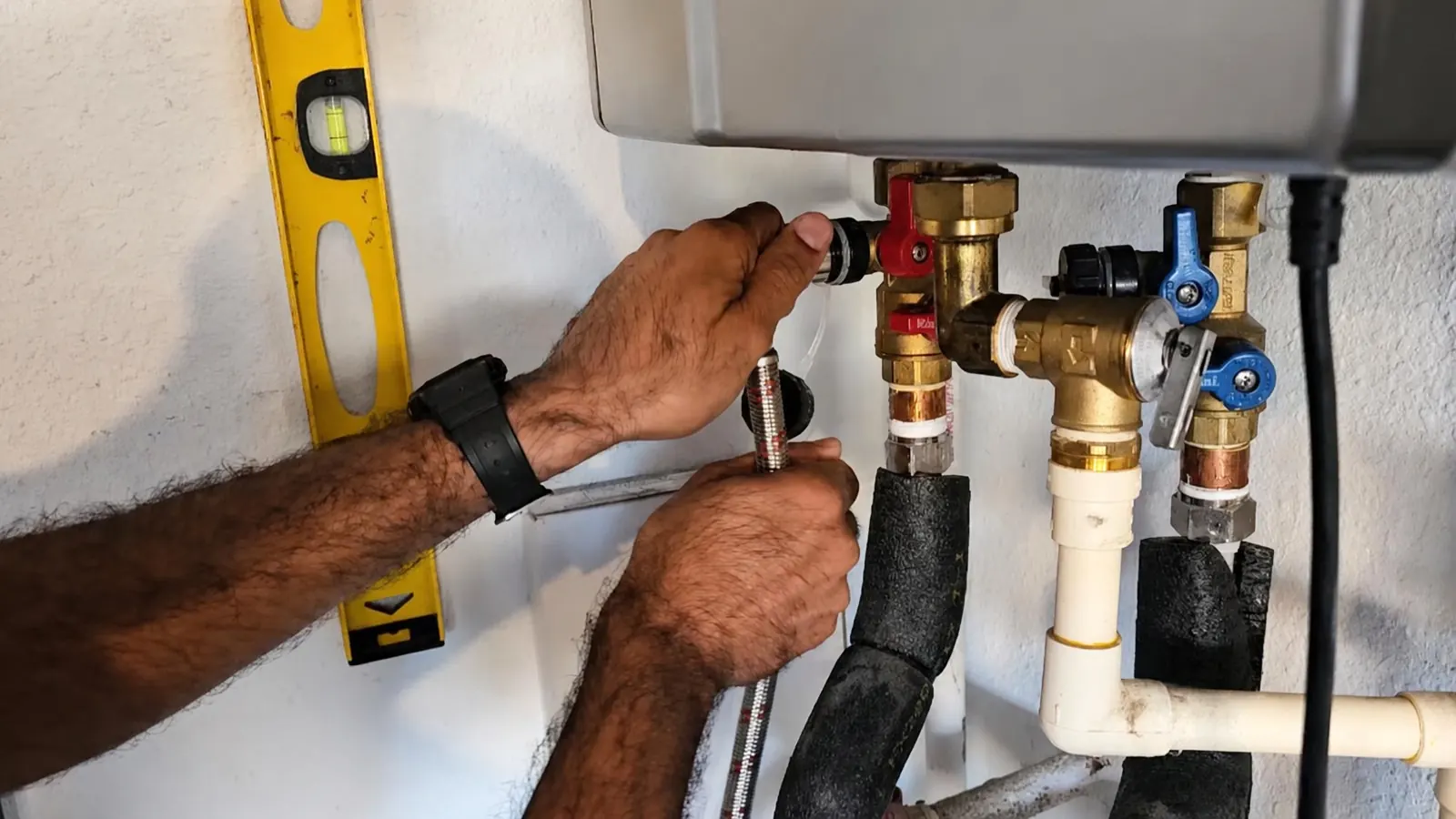
We add isolation valves with service ports so the unit can be flushed. Condensing models need a drain and sometimes a neutralizer.
Mount and connect
The unit hangs on a wall, so it frees floor space. We connect water, gas, vent, and power, then purge air from the lines.
Set and test
We set the temperature, verify flow, and check for error codes. We then show you the controls.
Call and describe your household. We will say whether a tankless unit fits your gas supply and layout.
Hard water and tankless maintenance
Tankless heat exchangers have narrow passages, and scale from hard water can block them. Hanover Park receives Lake Michigan water via the Chicago system. The Streamwood 2023 report for the same supply lists 8 grains per gallon, which is moderately hard. That is enough that tankless units here usually need regular flushing.
Manufacturers generally call for an annual flush with a descaling solution, often white vinegar or a labeled descaler, circulated through the heat exchanger using the service valves. Skipping it leads to error codes, reduced flow, and a lukewarm output. A water softener reduces scale at the source and extends the time between flushes.
Common tankless error causes
- Ignition failure from a closed gas valve, low gas pressure, or a dirty flame rod.
- Overheating shutdowns from scale on the heat exchanger.
- Flow errors from clogged inlet screens or a stuck flow sensor.
- Condensate drain blockages on condensing models.
- Vent pressure faults from blocked or crushed exhaust piping.
Hanover Park homes and tankless readiness
Many homes here date from the 1960s and 1970s, so gas lines are often sized for a furnace and a tank heater rather than a 199,000 BTU unit. That does not rule tankless out, but it can mean a larger branch line. We measure first so you do not buy a unit your gas supply cannot feed.
Venting is easier than with an old chimney because condensing models exit through a side wall. Basements with low ceilings are fine, since the unit mounts on the wall. Permits come through the village Inspectional Services Division, and registered contractors only.
What affects tankless water heater cost
Tankless jobs vary more than tank swaps. These are the factors that shape the total.
Unit capacity and brand
Higher flow and condensing efficiency raise the unit price.
Gas line and meter work
A larger gas branch line is the most common extra.
Venting route
Longer or more complex vent runs through walls and joists add labor.
Water treatment and valves
Service valves, a condensate neutralizer, and optional softening add parts.
Permit and electrical
Permit fees and a new outlet or circuit for the unit may apply.
Call us for a clear price after we check your gas supply.
If you decide a tank still suits you better, see water heater replacement or water heater repair. We will not push a tankless unit on a home where it is a poor fit.
Codes and standards that apply
Tankless installs follow the manufacturer's venting and gas sizing instructions together with the Illinois Plumbing Code (77 Ill. Adm. Code 890). Check that the installer is registered with the village before any permit is pulled.
Common questions
Possibly. Whole-house gas units use far more gas than a tank, so we measure your line size, length, and other appliances. Some homes need a larger branch line.
Manufacturers generally say once a year. In Hanover Park, where the Chicago supply is moderately hard, an annual flush matters. Skipping it can cause error codes and low flow.
Common causes are scale on the heat exchanger, a clogged inlet screen, or demand beyond the unit's flow rating. A flush and a screen cleaning often fix it.
Yes. The Inspectional Services Division issues plumbing permits to registered contractors. We pull the permit and arrange the inspection.
Usually not. Tankless units vent through PVC, polypropylene, or stainless pipe, often out a side wall. An old masonry chimney is oversized and can condense moisture.
Yes. Softening removes the minerals that scale the heat exchanger, so flushes are needed less often and the unit runs more efficiently.
Talk through a tankless upgrade
Call Hanover Park 24/7 Plumbing. We check gas supply, venting, and layout before you commit.