
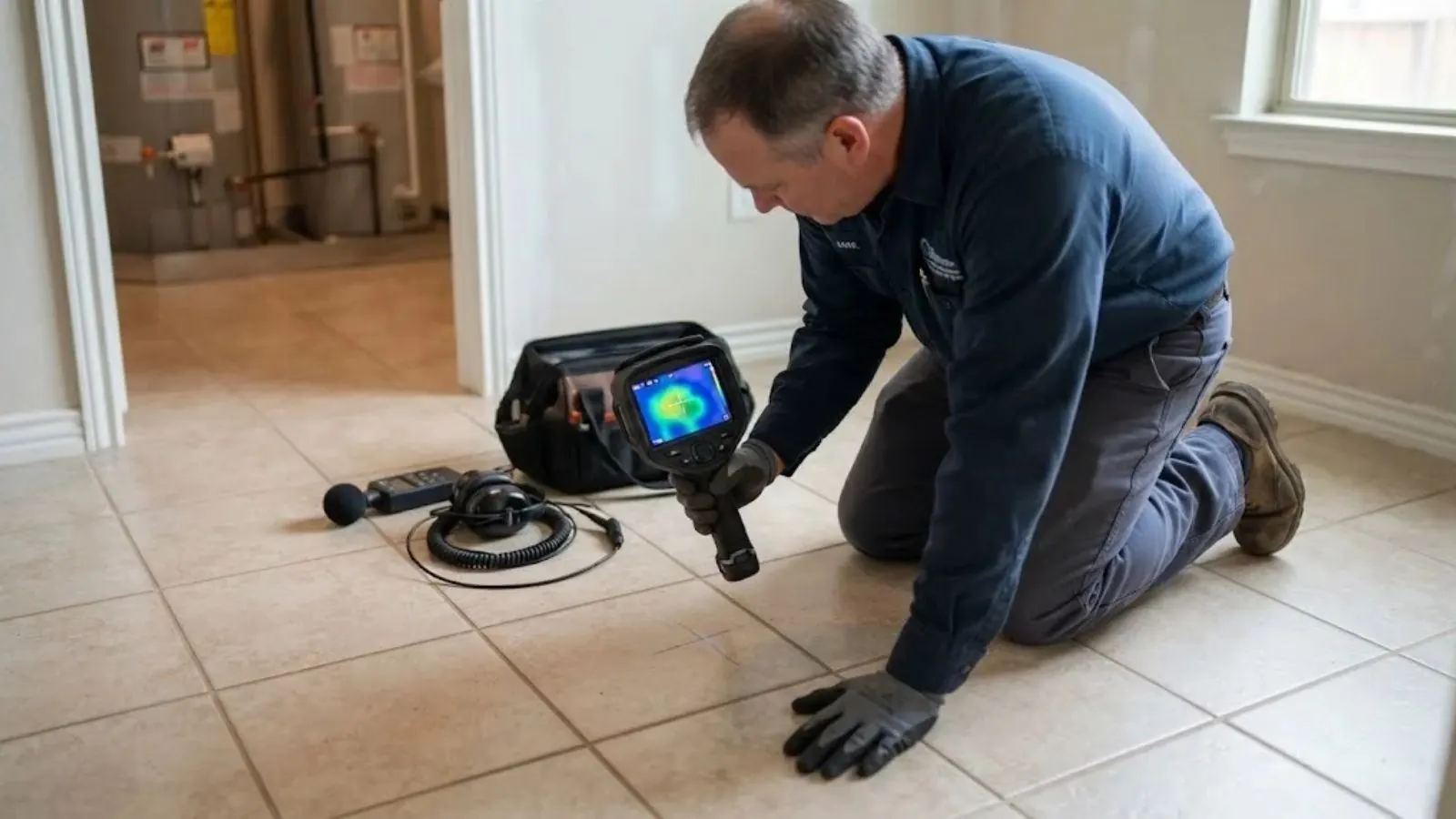
Emergency Leak Detection in Hanover Park, IL
Water where it should not be, a meter that keeps spinning, or a bill that jumped for no reason. Shut off what you can, then call, and we will trace the source.
What to do right now
If water is visible and spreading, close the nearest fixture shutoff first. Under a sink or behind a toilet, the small oval handle turns clockwise to close. If the source is unclear, close the main shutoff where the line enters the house, usually near the water meter in the basement or utility room.
Then open a low faucet to relieve pressure and keep water off electrical outlets, panels and cords. Move rugs and boxes off wet floors. Take photos of any stains for your records, and call us. A leak you cannot see is still running, and wet framing starts to rot and grow mold within days.
Wet ceiling or bulging drywall
Do not poke it open over your head. Trapped water can release all at once. Put a bucket under it, shut off the main, and let us open it in a controlled spot.
Signs of a leak you cannot see
Most hidden leaks give small hints long before water drips. Catching those hints early keeps a pinhole from turning into a rotted subfloor. These are the signs we hear about most from Hanover Park homeowners.
- A water bill that climbs while your habits stay the same
- Sound of running water when every tap and appliance is off
- Warm spots on a floor, which can point to a hot water line
- Musty smell in a closet, cabinet or basement corner
- Peeling paint, stained drywall or lifting laminate flooring
- Low water pressure that appeared without a clear cause
- A meter dial that moves with all fixtures closed
Call us at any hour. A technician can start with a meter check and listening gear, then tell you where the water is going.
How we find the leak
We start by narrowing the search, because the fewer walls we open, the less you repair afterward. Which method we use depends on whether the pipe is hot, cold, pressurized, buried or inside a wall.
Isolate the system
We close valves section by section and watch the meter. If the dial stops after one zone is closed, the leak is in that zone.
Pressure test the lines
A gauge on the supply shows whether the system holds pressure with fixtures closed. A steady drop confirms a leak and helps rule out a fixture.
Listen with acoustic gear
Ground microphones and contact sensors pick up the hiss of water escaping a pressurized pipe. The sound is loudest right over the leak.
Scan with thermal imaging
An infrared camera shows temperature differences behind drywall and under floors. Hot water leaks stand out as warm patches, and wet materials often read cooler.
Confirm before cutting
We cross-check two methods, mark the spot, and cut the smallest opening that gives access to the pipe.
Reading your own water meter
You can run a basic test before we arrive, and it tells us a lot. Your meter is usually in the basement or utility room near where the water line enters the home. Many meters have a small low-flow indicator, often a triangle or star, that turns when even a trickle passes through.
- Turn off every faucet, the dishwasher, washer, ice maker and irrigation.
- Look at the low-flow indicator. If it is turning, water is moving somewhere.
- Write down the meter reading and wait at least an hour without using water.
- Read it again. Any change means a leak between the meter and your fixtures.
If the meter moves but the house shows no damage, the leak may be in the yard, under a slab or in the line between the meter and the foundation. That is when acoustic equipment earns its keep. See our page on water line repair for what happens after a buried line is located.
| What you notice | Likely source | How we confirm |
|---|---|---|
| Meter moves, no visible water | Buried service line or under-slab pipe | Pressure test, then ground microphone |
| Stain on a ceiling below a bathroom | Supply line, drain or shower pan | Thermal scan and moisture meter |
| Warm spot on floor | Hot water line in slab or subfloor | Infrared camera and acoustic contact |
| Bill up, no damage anywhere | Running toilet or dripping fixture | Dye tablet test and meter check |
| Low pressure in one area | Pinhole in galvanized or copper branch | Isolation valves and pressure gauge |
The silent toilet leak behind many high bills
Before anyone looks under a floor, check the toilets. A worn flapper lets water slip from the tank into the bowl all day with no sound. The EPA WaterSense program reports that a typical household loses thousands of gallons a year to leaks and that toilet flappers are a leading culprit.
Drop a few drops of food coloring in the tank and wait fifteen minutes without flushing. If color shows in the bowl, the flapper is leaking. It is a cheap part and a short fix, and we would rather start there than open a wall. If the dye stays put, see toilet repair only if the fill valve also runs on.
Why leaks show up in Hanover Park homes
Much of the housing here was built in the 1960s and 1970s, in neighborhoods such as Greenbrook, Woodlake Trails and Olde Salem. Pipes from that era are often copper with soldered joints, or galvanized steel that rusts from the inside. Both can develop pinholes after decades, so an older home deserves a closer look when a stain appears.
The village supplies 100% Lake Michigan water, bought through the Northwest Suburban Municipal Joint Action Water Agency. Reports for the same Chicago supply describe moderately hard water, around 8 grains per gallon. Hard water leaves scale that can clog valves and speed wear on fittings, which is one reason we also suggest a water softener for some households.
Whose pipe is it? Village side versus your side
Hanover Park maintains roughly 122 miles of water mains serving about 10,826 metered customers. The leak could be on the village main, at the meter, or on the private line from the curb to your home. Knowing which saves time and money. If water is surfacing in the street or parkway, tell Public Works at once, since they handle the public main.
The village also keeps a service line inventory on its water quality page, and Illinois law requires suppliers to track lead service lines and replace the entire line when one is repaired. That means a line fix on an older property can turn into a full replacement, so check the inventory before work starts.
What affects the cost of finding and fixing a leak
Locating a leak is one job and repairing it is another. Here is what moves the total.
Where the leak is
A leak under an exposed basement pipe is quick. One under a slab or deep in a yard takes longer to reach.
Method needed
A meter test is simple. Combining acoustic, thermal and gas tracing takes more equipment and time.
Pipe material
Copper, galvanized, PEX and old lead each repair differently, and corroded pipe may need a longer section replaced.
Access and finishes
Tile, hardwood, cabinets and finished ceilings add repair and restoration work after the pipe is fixed.
Permits
Larger repairs or line replacements may need a village permit through Inspectional Services.
Many insurers handle water damage case by case, so ask yours before any demolition and keep photos of what we find.
Call and describe what you see. We will explain the likely steps and cost factors before work begins.
After we find it
Once the leak is located, we tell you what we found and what the repair involves. Small fixes, like replacing a corroded fitting, are often done the same visit. If the pipe is failing along its whole length, a patch will not last. In that case we discuss repiping so you are not chasing a new pinhole every year.
If a pipe has already burst, the job is different and more urgent. Our burst pipe repair page covers the shutoff steps and what we do on arrival.
Hanover Park permits and who can do the work
Plumbing work in the village goes through the Inspectional Services Division on Lake Street. Contractors must be registered with the village, holding Illinois IDPH 055 contractor registration and a 058 plumber licence, and permits are not issued until that registration is in place. The office is closed Wednesdays.
For you, that means ask any plumber for proof of registration before they open a wall or dig a line. IDPH has an online tool to verify a licence, and it takes a minute.
Source type: Hanover Park Inspectional Services and IDPH
Codes and standards that apply
Hanover Park keeps a service line inventory dashboard on its water quality page, which shows what material the village records for the line serving a property. It is a useful starting point when a leak is suspected between the meter and the house.
Common questions
Yes. If water is actively spreading, shut off the main at the meter and call right away. We answer around the clock and can start tracing the source at any hour.
While you wait, keep water away from outlets, lift valuables off the floor, and photograph the damage.
We combine a pressure test, acoustic sensors and an infrared camera to narrow the location to a small area. Two methods have to agree before we cut. Then we open only a small access hole near the pipe.
Yes, in most cases. We isolate the lines, pressure test them, and use contact microphones on the slab to pinpoint the sound of escaping water. Hot water lines can also show up on a thermal scan as a warm patch.
Do the meter test with all fixtures off, then check each toilet with dye in the tank. Those two steps find most causes. If the meter still moves, the leak is in a line you cannot see and we should trace it.
The village maintains the water main. The private line from the curb or meter to your home is generally yours. Public Works can tell you where the village side ends, and our technician can confirm which section is leaking.
Simple fixture and fitting repairs often do not. Replacing a service line or a long run of pipe usually does. Inspectional Services issues plumbing permits, and we pull them when the work calls for it.
Scale does not create leaks by itself, but it clogs valves and speeds wear on fittings and water heaters. Reports for the same Chicago supply describe moderately hard water, so scale is a common finding in older homes here.
Find the leak before it finds your floor
We answer around the clock in Hanover Park. Call and tell us what you are seeing or hearing.