Tankless Water Heater Not Working in Hanover Park, IL
Cold water, an error code, or a unit that shuts off mid-shower usually has a short list of causes. Here is how to sort them.
Start with the display
Most tankless heaters show a numeric code when something is wrong. Write the code down before you reset anything, and check the manual for your brand. The code tells you which system failed: air, gas, flame, water flow, or temperature.
Common causes of no hot water are a blocked vent, a closed gas valve, scale inside the heat exchanger, a flow too low to fire the burner, or a full condensate trap. The sections below take them in order, easiest first.
Quick checks before any code
- Confirm the unit has power and the display is lit.
- Check that the gas shutoff is open and other gas appliances work.
- Make sure the cold water valve and hot water isolation valves are open.
- Look for a tripped breaker or a GFCI outlet that needs reset.
- Open a hot tap fully to see if the unit fires.
- Check that nothing blocks the vent terminal outside.
A tankless unit only runs when it senses water moving. If it does not start at one faucet but does at another, the problem is flow or a clogged fixture, not the heater.
What common error codes mean
Codes vary by brand, so use your own manual. The examples below come from Rinnai's technical bulletin on condensing models and show the pattern most makers follow.
| Code | Meaning | First thing to check |
|---|---|---|
| 10 | Air supply or exhaust blockage | Vent terminal, vent joints, and fan |
| 11 | No ignition | Gas supply, igniter, and burner |
| 12 | Flame failure | Gas pressure, flue outlet, and flame rod |
| 16 | Over temperature warning | Airflow, low flow, and heat exchanger |
| 25 | Condensate trap error | Condensate drain and trap |
| 52 | Modulating valve signal abnormal | Valve wiring harness |
Codes 10 and 25 are the ones owners can often clear themselves, by freeing a blocked vent or condensate drain. Codes 11, 12, and 52 point to gas or electrical parts that need a technician.
Scale buildup and the flush
Hard water leaves mineral scale inside the heat exchanger. The coating cuts heat transfer, raises exhaust temperature, and can trigger overheat codes or a weak, lukewarm output. A unit that was fine last year may start to cycle on and off.
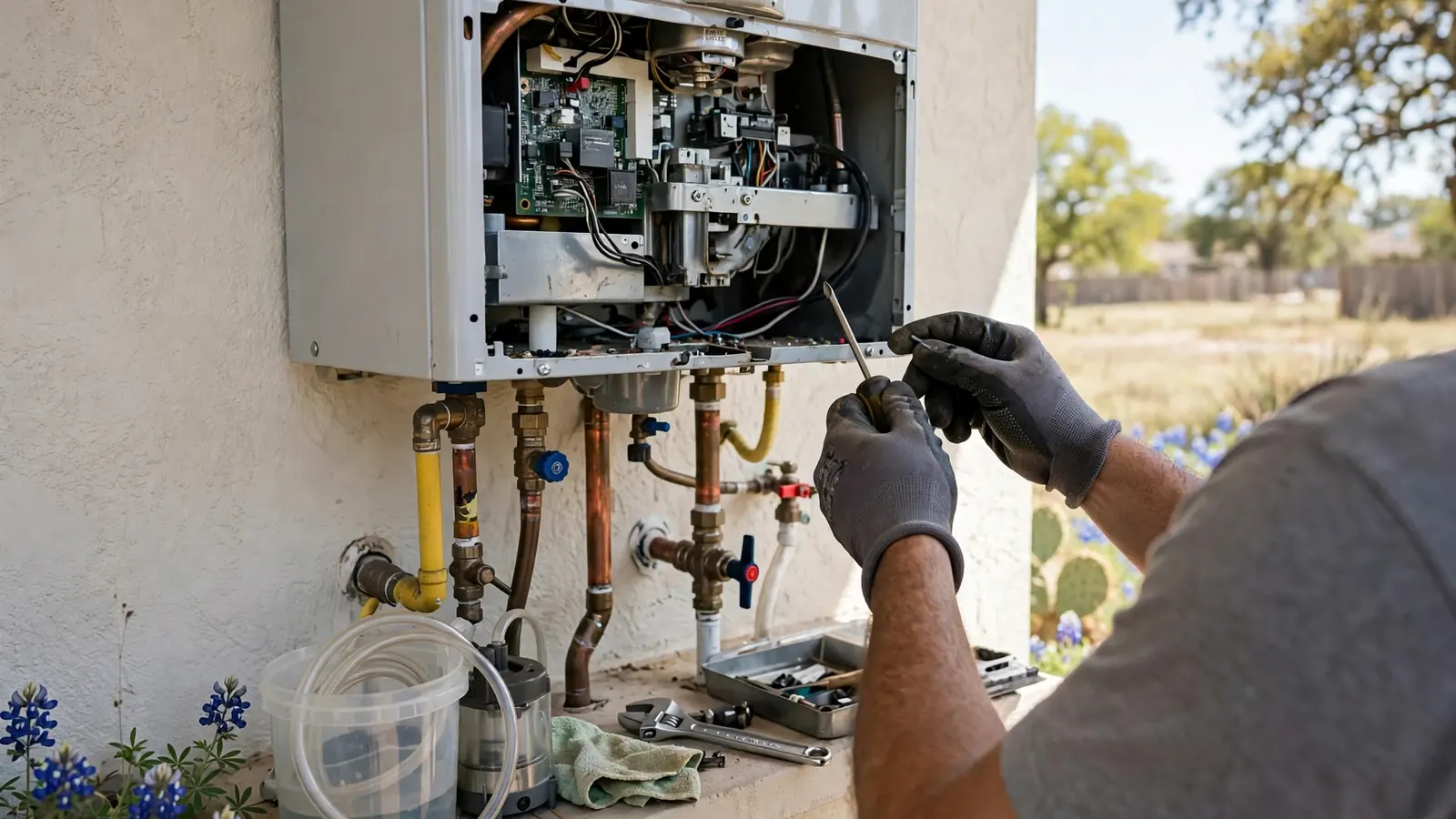
Flushing removes it. Close the isolation valves, connect hoses to the service ports, and circulate white vinegar or a descaling solution through the unit with a small pump for about 45 minutes. Then rinse with clean water and open the valves.
Most makers advise a flush about once a year in hard water areas. Skipping it is the most common reason tankless units fail early. Clean the inlet water filter screen at the same time.
Flow rate: why the burner will not fire
Every tankless model has a minimum flow, often around half a gallon per minute, below which the burner will not light. Low-flow fixtures, a clogged aerator, or a partly closed valve can sit under that threshold.
The reverse also happens. If you run two showers and a washer at once, demand can exceed what the unit can heat, and the water turns lukewarm. Check the rated flow on your model against what the house is asking for.
A cold water sandwich, a short burst of cold between hot slugs, is a normal trait of tankless systems and not a fault. Short taps and long pipe runs make it worse.
If the display shows a gas, ignition, or flame code, a technician should look at it. Call us any time.
Gas supply problems
Tankless heaters pull a large volume of gas when they fire. An undersized line, a partly closed valve, or low pressure can starve the burner and cause ignition or flame codes. This often shows up after a second gas appliance is added.
Do not adjust gas pressure or open the burner area yourself. If you smell gas, leave the house, then call the gas utility and emergency services from outside. Gas work belongs to a licensed plumber.
Condensate drain and vent issues
Condensing tankless models make acidic water that drains through a small trap and a plastic line. Debris or a kinked hose can back it up, trip a condensate code, and shut the unit down. Clear the trap and make sure the line slopes toward the drain.
In winter, an outdoor vent terminal can be blocked by snow, and a poorly routed condensate line can freeze. Keep the terminal clear and the line inside conditioned space.
Power, ignition, and sensors
A tankless heater needs steady power for its fan, controller, and igniter. A loose cord, a tripped GFCI outlet, or a power surge can shut it down. Check the outlet with a lamp or phone charger before blaming the heater.
Flame rods and thermistors are small sensors that wear with age. A dirty flame rod causes flame failure codes, and a bad temperature sensor causes swings between hot and cold. Cleaning or replacing them is quick for a technician but not something to guess at.
If the display is blank, check the breaker first. A dead board is rare, but a dead outlet is common, and it costs nothing to rule out.
Hard water and Hanover Park homes
What Hanover Park water means for a tankless heater
Hanover Park gets 100 percent Lake Michigan water through the Northwest Suburban Municipal Joint Action Water Agency, and Chicago treats it. The village's own reports show no hardness figure. Streamwood's 2023 report for the same Chicago supply cites 8 grains per gallon, or 128 to 144 mg/L as calcium carbonate.
That is moderately hard water. Expect scale in a tankless exchanger, and plan a yearly flush. A water softener installed ahead of the heater cuts the scale load. See water softener installation if you want to protect the unit.
Source type: Streamwood 2023 water quality report (same Chicago supply) and Village of Hanover Park
When to call a plumber
Call for tankless water heater service if codes return after a reset, the unit smells of gas, or there is water at the base. Ignition and flame faults need parts and gas testing, which is licensed work.
If the unit is old and failing repeatedly, ask about water heater replacement. Neighbors in Bloomingdale and Schaumburg have the same concerns, since scale and gas supply are the usual culprits.
Codes and standards worth knowing
Tankless units are installed and serviced to the maker's published guidelines together with the Illinois Plumbing Code (77 Ill. Adm. Code 890). Gas and venting work should not be improvised.
Common questions
The usual causes are low flow, scale in the heat exchanger, a blocked vent, or a full condensate trap. The error code narrows it down.
Many makers advise once a year in hard water areas. Your manual gives the exact interval for your model.
You can power cycle it to clear a one-time fault. If the same code returns, the cause is still there and needs checking.
Demand may be higher than the unit's rated flow, or scale may be limiting heat transfer. A cross connection in a mixing valve can also do it.
Condensing models do. They produce acidic condensate that must drain to a floor drain or neutralizer, per the manufacturer.
Yes. Reports for the same Chicago supply cite about 8 grains per gallon. That level leaves scale over time, so schedule a yearly flush.
Tankless heater on the blink?
Our crew is on call around the clock in Hanover Park. Call and give us the error code.