
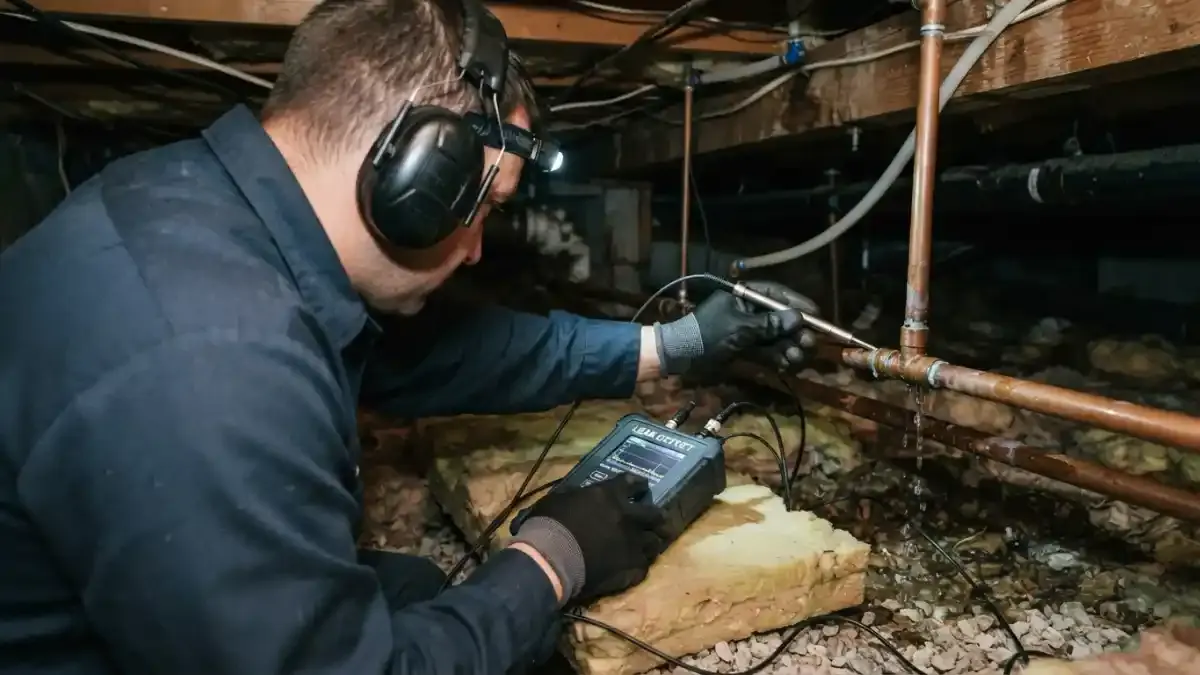
How Professional Leak Detection Works in Hanover Park
Plumbers find hidden leaks without tearing walls open by reading the meter, listening to pipes, scanning for heat and using tracer gas.
The quick answer: start with the meter
Professional leak detection starts with a meter test, then narrows the search with acoustic listening, thermal imaging and tracer gas. Each method answers a different question. The meter says whether water is escaping at all, and the other tools say where.
You can run the first test yourself in a few minutes. If the meter keeps moving with every fixture off, call us and we will bring the equipment to pinpoint the break. Our leak detection work starts exactly there.
How to read your water meter for a leak
Find the meter
In many homes it sits in a basement or utility room, often near where the main line enters. Some are in an outdoor pit with a lid.
Read the dials
Four white dials on the left usually show billed usage. One cubic foot is 7.48 gallons. Black dials or a small colored triangle or asterisk respond to even slow flow.
Shut everything off
Turn off all faucets, the ice maker, irrigation and appliances. Make sure no one runs a toilet or washer.
Watch the low flow indicator
Wait a couple of minutes. If the triangle or dial still turns, water is moving somewhere.
Close the main shutoff and repeat
If the dial stops, the leak is inside the house. If it keeps moving, the leak is between the main valve and the meter or on the supply pipe outside.
Take a photo of the dials and check again after an hour of no use. A change in the number with every fixture off confirms a leak. A toilet flapper that does not seal is the most common culprit, so do the dye test with a few drops of food coloring in the tank.
The tools plumbers use to locate a leak
| Method | How it works | Best for |
|---|---|---|
| Meter test | Compares readings with all fixtures off | Confirming that a leak exists |
| Acoustic listening | Sensitive microphones pick up the hiss of pressurized leaks | Supply lines under slabs or in walls |
| Thermal imaging | Infrared camera shows temperature differences | Hot water lines, radiant floors, wet drywall |
| Tracer gas | Safe hydrogen mix is pushed into the pipe and sniffed from above | Small leaks in drain or supply lines |
| Pressure test | Isolated sections are held under pressure | Confirming which line is leaking |
| Camera inspection | Camera crawls the pipe | Drain lines and cracked sewer pipes |
Acoustic gear works best in quiet conditions, so we often shut off nearby sources. Thermal cameras do not see water, only temperature changes, so the result is read together with moisture meters and what the homeowner has noticed.
Signs of a hidden leak
- A water bill that jumps when your habits have not changed
- A musty smell or warm spot on a floor
- Peeling paint, bubbled drywall or stained ceilings
- The sound of running water when nothing is on
- Low pressure at several fixtures at once
Slab leaks on hot lines often show as a warm patch on tile or carpet. Outside, a soft, wet strip of lawn in dry weather can point to a failed service line.
Call and we will bring acoustic, thermal and tracer gear to find the exact spot.
Why finding it first saves money
Opening walls to hunt for a leak damages finished surfaces and costs more than the repair itself. Locating the break first limits the cut to a small patch. In a house with copper or galvanized pipe from the 1960s and 1970s, pinhole leaks tend to show up in clusters, so finding one often points to another.
If the leak is on the outdoor line between the house and the meter or main, the fix may be water line repair, which sometimes means digging a short trench instead of an entire yard.
What a typical visit looks like
A technician starts by asking where you noticed the problem. Then comes the meter test, a walk through the house with a moisture meter and a look at fixtures. Next comes the equipment that fits the clues. A quiet hiss in a wall calls for acoustic listening, and a warm patch on a floor calls for the thermal camera.
When the readings do not agree, the plumber isolates sections of pipe and pressure tests each one. This narrows a whole house down to one wall or one stretch of floor. Then the plan is simple: open a small access, repair or replace the damaged pipe and dry the area before anything is closed up.
Ask for a note of where the leak was and what was found. It helps with insurance questions, and it lets you watch that area for the next few years.
Leaks outdoors and under the lawn
Not every leak is inside. A cracked service line between the main valve and the street can lose water for months before anything shows. Signs include a lawn patch that stays green or soggy in dry weather, a sinkhole-like dip, or the sound of rushing water near the curb stop. The meter test with the main valve closed helps confirm it.
Sprinkler zone valves and hose bibs also leak. Shut the irrigation system off at its own valve and test the meter again to rule it out.
What Hanover Park's water system tells you about a high bill
The village maintains 122.1 miles of water mains and serves 10,826 metered customers. Each customer has a meter that records every gallon, so a leak on your side shows up as a bill that climbs. The village also has a service line inventory dashboard on its water quality page.
The practical meaning is that your meter is the ground truth. Public Works, at 2041 Lake Street, handles the water supply side up to the meter, and everything past it is yours. Do the meter test first, because it tells you which side of that line to fix.
Source type: Village of Hanover Park Public Works and water quality page
What happens after we find it
Once the leak is located, you choose the repair. Options include replacing a short section, re-routing the line through the wall or ceiling, or in a worst case repiping a run. For a house with worn pipe throughout, our Schaumburg and Streamwood customers often compare spot repairs with a longer-term repiping plan.
Codes and standards worth knowing
The village publishes a service line inventory on its water quality page, and Public Works at 630-823-5700 can answer questions about the meter and the water main. Repairs follow the Illinois Plumbing Code (77 Ill. Adm. Code 890).
Common questions
Read your meter, shut off all water use and watch the low flow indicator for a couple of minutes. If it keeps moving, you likely have a leak.
Yes. A flapper that does not seal lets water run into the bowl all day. Put dye in the tank and wait. If color shows in the bowl, replace the flapper.
Not directly. It shows temperature differences, such as a cooler wet spot or a hot pipe. The reading is confirmed with moisture meters.
No. The listening, thermal and gas methods are non-invasive. Opening is limited to a small repair patch once the leak is located.
The village's Public Works at 2041 Lake Street covers the supply system up to the meter. Past the meter, the line is the homeowner's responsibility, so the meter test tells you which side to call about.
Find the leak before it finds your ceiling
Call and we will test, locate and explain your repair options.