
How to Install a Submersible Sump Pump in Hanover Park
A submersible pump sits in a sealed basin, pushes water out through a check valve and discharge line, and needs a backup for outages.
What the job involves, in short
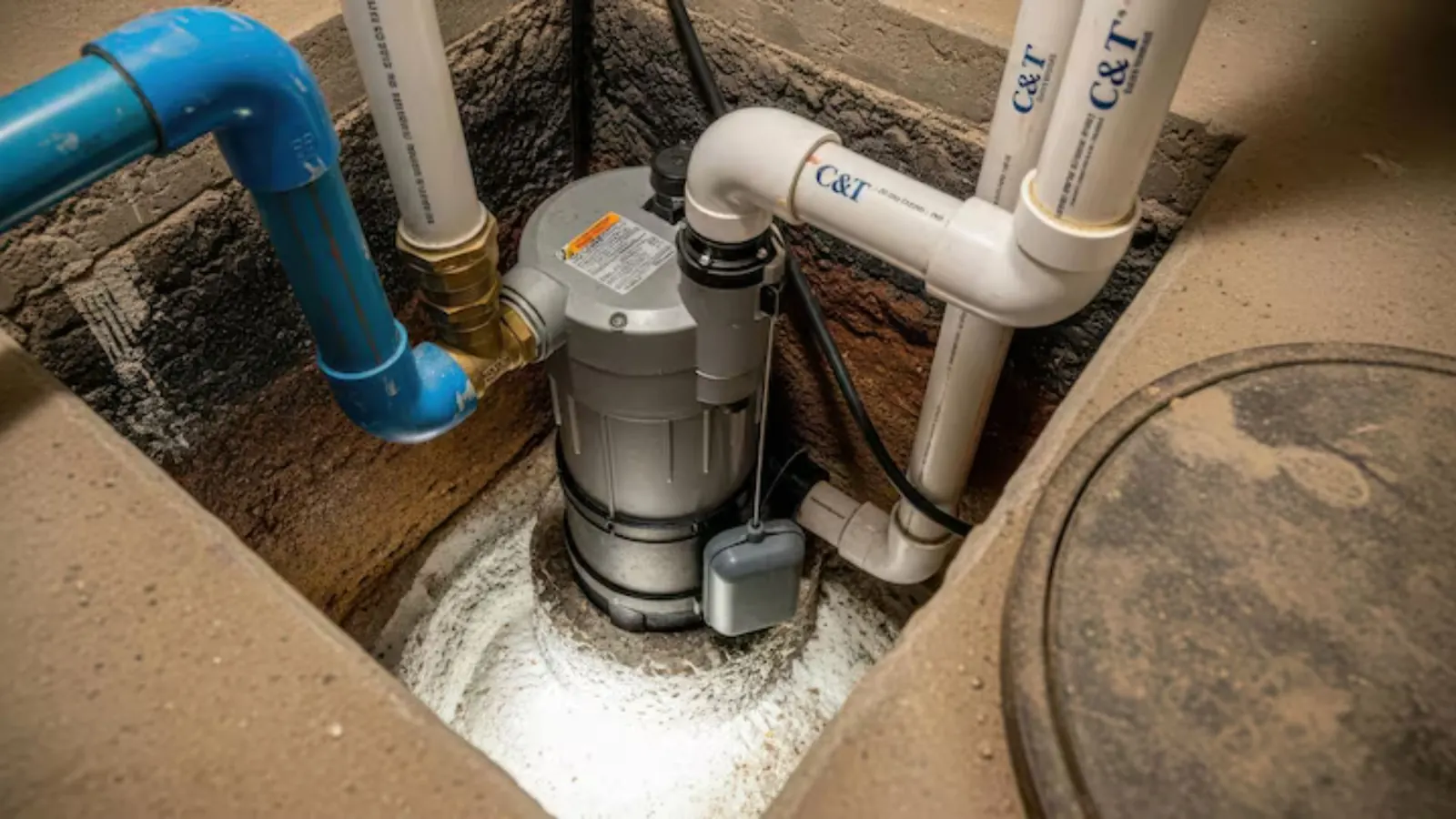
Installing a submersible sump pump means setting a basin below the floor, placing the pump on a firm base, adding a check valve, running a discharge line outside and connecting power. You break a hole in the slab, dig a pit, and make sure water drains into it. A battery backup is a strong addition in this area.
Expect a full day if you are doing the work yourself and the floor must be cut. Most people who try it find the slab cutting and discharge routing the hardest parts. If you would rather have a plumber set it, see our sump pump repair and installation work.
Parts and tools to gather first
- A sump basin, commonly 18 inches wide and about 24 inches deep, with a lid
- A submersible pump with a vertical float switch or a tethered float
- A check valve for the discharge pipe, and PVC pipe and fittings
- Washed gravel, a masonry saw or jackhammer, and a shovel
- A dedicated, grounded outlet protected by a GFCI
Step by step: the installation
Mark and cut the floor
Choose a low spot near the wall where water already collects. Outline the basin plus a few inches. Cut the slab along the line with a concrete saw and break out the piece. Wear eye and dust protection.
Dig the pit
Dig the hole a few inches deeper than the basin, because you need a layer of gravel under it. Water should be able to seep in from the sides and bottom, so keep the gravel clean and coarse.
Set the basin
Place the basin level on the gravel. Backfill around it with gravel up to the slab line. Patch the concrete around the rim so the top sits flush with the floor.
Place the pump
Set the pump on a flat base such as a paver, not directly in the dirt or gravel. Debris pulled into the intake wears out the impeller. Make sure the float can swing freely and does not hit the wall.
Add the check valve and weep hole
Glue a short pipe on the pump outlet and install the check valve above it with the arrow pointing up. Drill a small weep hole in the pipe below the valve to stop air lock.
Run the discharge line
Route the pipe out through the rim joist. Slope it away from the house and end it where water will not flow back toward the foundation. Use rigid pipe and secure it at intervals.
Test it
Pour in water until the float rises. The pump should turn on, empty the basin and shut off. Watch for backflow, leaks at the unions and any rattling.
Why the check valve matters
Without a check valve, water in the vertical discharge pipe falls back into the basin each time the pump shuts off. The pump then cycles on and off, wears out and may never keep up in a heavy storm. A quality valve also quiets the slap you hear when the water drops.
Install the valve where you can reach it, and use rubber couplings with clamps so you can replace it later. Check valves wear out over the years. A noisy or short-cycling pump is often a sign it has failed.
| Feature | Submersible | Pedestal |
|---|---|---|
| Where the motor sits | Inside the basin, under water | Above the basin, on a column |
| Noise | Quieter, since water muffles it | Louder |
| Basin needed | Sealed lid helps with humidity and radon | Open or narrow pit works |
| Service life | Often longer when kept clear of debris | Often easier to repair |
Battery backup and power
Storms that flood basements often knock out power at the same time. A battery backup pump on its own float switch, set a bit higher in the basin than the main pump, takes over when the primary quits or the grid goes down. Some systems use a separate small basin pump, others use a water-powered unit.
Test the backup twice a year and replace the battery on the maker's schedule. Never run the discharge into a sanitary sewer drain, since that is against most municipal codes and overloads the sewer in the same storm that is flooding your block.
If cutting the slab and routing the discharge sounds like too much, give us a call and we will take it from there.
Sizing the pump and reading the float
Pump size is measured by how much water it moves against the height it has to lift. A one third horsepower unit handles many ordinary basements. A house in a low spot, or one where the pit fills fast in a heavy rain, does better with a larger motor. A pump that is too small runs nonstop and burns out.
Floats come in a few styles. A tethered float swings on a cord and needs room in the basin. A vertical float slides on a rod and fits tight pits. Whichever you pick, test that it cannot snag on the pipe or the basin wall, because a stuck float is the most common reason a good pump fails to start.
Keep a small lid on the basin. It stops debris and children's toys from falling in, and it cuts down on humid air and odors rising from the pit.
Flood history behind the sump question in Hanover Park
The Cook County hazard mitigation annex lists flood-prone areas in Hanover Park, including the Anne Fox School Creek area, the Barrington and Irving Park Road corridor, the Highlands subdivision and Schick Road. The village has had federal flood declarations in 1972, 1973, 1986, 1987, 1993, 2013 and 2023.
The practical meaning is that a pump here is not an extra. If your home is near one of those areas, size the pump generously and install a battery backup. The village adopted a flood damage prevention ordinance on July 19, 2012, so ask Inspectional Services if your work or discharge routing needs review.
Source type: Cook County hazard mitigation plan, Hanover Park annex
When to call a plumber instead
Call a plumber when the slab is cracked or the basin sits in clay that does not drain, when the discharge must cross a long run or tie into a storm sewer, or when the electrical outlet is not grounded. If the water is coming from a high water table all year, you may also need basement waterproofing to take pressure off the pump.
Neighbors in Bartlett and Roselle face the same spring melt and storm surges, so these steps apply across the area.
Codes and standards worth knowing
County hazard planning lists the Anne Fox School Creek area, Barrington and Irving Park Road, the Highlands subdivision and Schick Road as flood-prone. The village flood damage prevention ordinance (Chapter 38, Article VII) is the local standard for work in mapped flood areas.
Common questions
Most residential basins run about 24 inches deep and 18 inches wide. The pit must be deep enough that the float can rise and fall without the pump running dry.
Several feet away from the foundation, on ground that slopes away from the house. Never tie it into the sanitary sewer drain.
It depends on the work. A pump swap often does not, but cutting into the slab or changing drain connections may. Call Inspectional Services to confirm before you start.
Pour a bucket of water into the basin every few months and in early spring. Confirm the pump starts, empties the water and shuts off, and test the backup the same way.
The Cook County annex names the Anne Fox School Creek area, Barrington and Irving Park Road, the Highlands subdivision and Schick Road. If you live near one, treat a backup pump as part of the install, not an upgrade.
Keep the basement dry
Call for a sump pump check or a full install with a battery backup.