
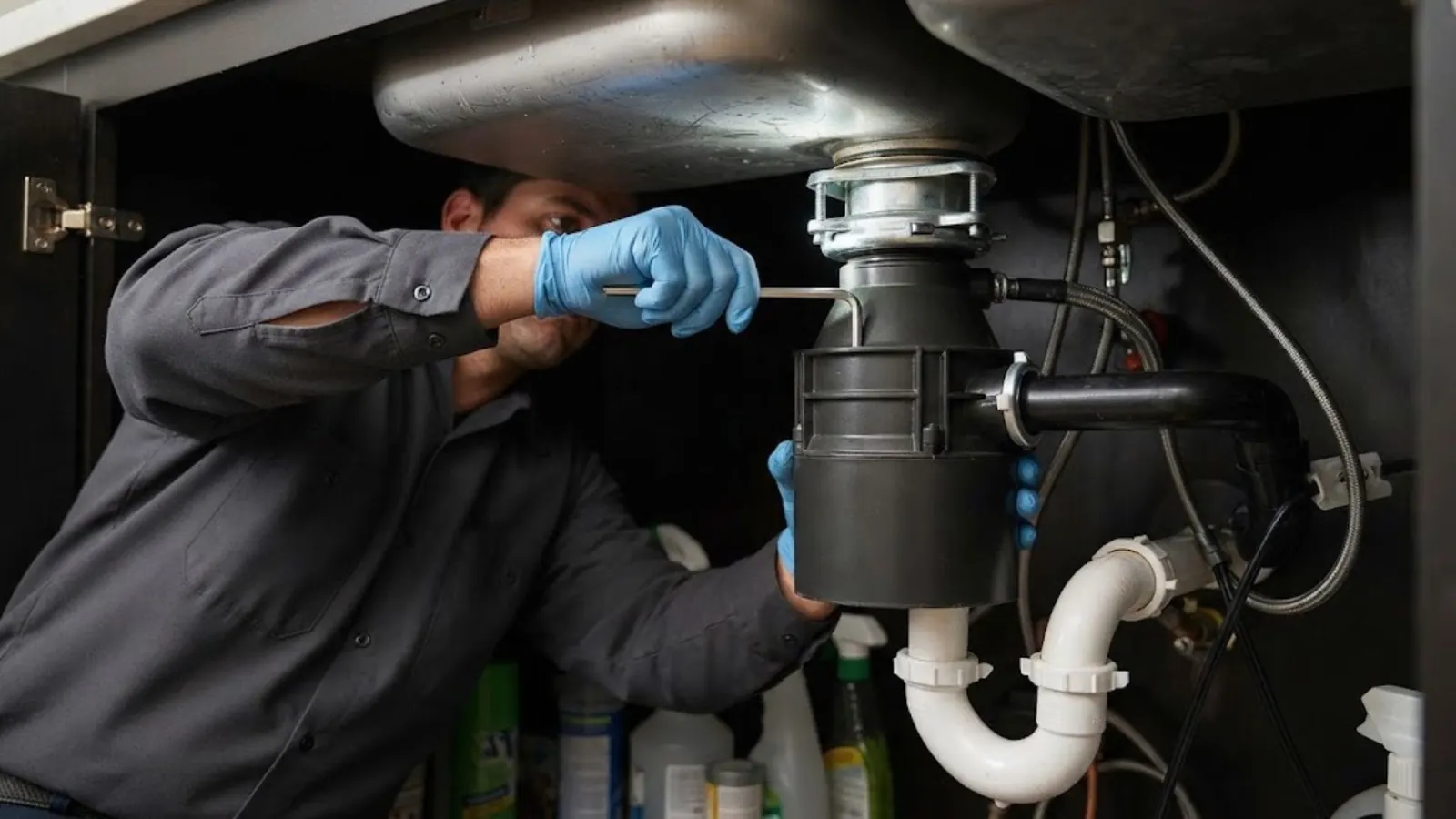
How to Install a Garbage Disposal Yourself in Hanover Park
A replacement disposal is a decent weekend job if the sink is already set up. New wiring and drain changes are better left to a plumber.
Can you install one yourself? Usually yes
Swapping an old disposal for a new one of similar size is a manageable DIY job. You detach the old unit, clean the sink flange, mount the new one and reconnect the drain and power. Most people finish in a couple of hours. A first-time install where there was never a disposal takes longer and may need new wiring.
If anything on the electrical side looks unfamiliar, stop and call. Our garbage disposal repair team handles both repairs and full installs.
What you need before you start
- A disposal with a matching mounting kit (sink flange, gasket, mounting ring)
- A power cord kit if the unit does not come with one
- Plumber's putty, a screwdriver, adjustable pliers and a hammer
- A bucket and towels for trapped water
- A tailpiece or drain elbow that fits your trap
Step by step: the DIY install
Turn off the power
Switch off the breaker that feeds the sink area and confirm with a tester. Unplug the old unit or disconnect its wires, and loosen the dishwasher hose and drain pipe.
Remove the old disposal
Twist the mounting ring on most models to drop the unit off its flange. Support it as it comes loose, since it is heavy. Take off the old flange by removing the snap ring or screws.
Clean and set the flange
Wipe the sink opening clean. Roll a rope of plumber's putty and press it under the new flange lip. Seat the flange in the opening from above.
Attach the mounting assembly
From below, slip on the gasket, backup ring and mounting ring, then tighten the screws evenly until putty squeezes out. Wipe the excess from the top.
Knock out the dishwasher plug
If a dishwasher drains through the unit, locate the small plug in the dishwasher inlet and knock it out with a screwdriver and hammer. Fish the plug out of the chamber. Forgetting it blocks the dishwasher drain.
Hang the unit
Lift the disposal onto the mounting ring and rotate until it locks. Connect the discharge elbow to the trap with its gasket and the dishwasher hose with a clamp.
Wire it and test
Attach the cord or wires, black to black, white to white and green to ground, inside the cover plate. Restore power, run cold water and flip the switch.
Run water for a minute and check every joint for drips. Tighten any that seep. Leaks at the sink flange mean the putty seal needs redoing.
The electrical side
Most disposals plug in to an outlet under the sink, which is wired to a wall switch. If your outlet is dead or there is no switch, you may need an electrician. The outlet should be grounded and protected as required by local code.
Never use the disposal as a place to add a new line. Shared circuits that also power the dishwasher or microwave can trip when the disposal starts. If the breaker trips on startup, the circuit may be undersized.
| Situation | DIY is reasonable | Hire a plumber |
|---|---|---|
| Replacing an existing unit | Yes, same size and mount | If the flange is corroded or leaking |
| First-time disposal | Maybe, with a plug-in outlet | If there is no outlet or switch |
| Dishwasher connection | Knockout and hose swap | If the air gap or high loop is missing |
| Double bowl sink | Possible with a proper drain kit | If the trap alignment is off |
| Septic or old galvanized drain | Not advised | Always |
Give us a call and we will finish the connections or fix a leak.
Choosing the right disposal for your sink
Look at three things before you buy: motor power, the type of feed and the mounting style. Continuous feed units run while the switch is on and suit most kitchens. Batch feed units only run with the stopper in place, which some households prefer for safety.
Check how much room you have under the sink. A larger unit with extra insulation sits lower and may bump into the trap. Measure from the sink flange to the trap arm before you shop. If the new unit is taller than the old one, the drain elbow and trap may need to move.
Look for a model with a stainless steel grind chamber and a sound-reducing shell if the kitchen is open to a living room. Quieter units cost more but are noticeably easier to live with.
Keeping the new disposal running
Run cold water before, during and for several seconds after each use. Cold water keeps grease solid so it gets chopped and flushed instead of coating the pipe. Grind small amounts at a time. Skip coffee grounds in quantity, eggshell piles, pasta and rice, which swell and clump in the trap.
Once in a while, grind a handful of ice cubes to knock residue off the blades, and wipe the splash guard with a brush. Never put your hand in the chamber, and always switch off the power before clearing a jam.
Older Hanover Park kitchens and the Illinois rules
Much of Hanover Park's housing was built in the 1960s and 1970s, with original kitchen drains in galvanized or cast iron that can be rough inside. A new disposal grinds food into fine pieces, but corrosion in the old pipe catches that waste and clogs.
Illinois allows owner-occupants to do their own plumbing work with a Homeowner Plumbing Affidavit under the state's plumbing code, 77 Ill. Adm. Code 890. The practical point is that you can legally install your own disposal, but call Inspectional Services at 2121 Lake Street to find out whether your drain changes need a permit.
Source type: Illinois Plumbing Code and Village of Hanover Park Inspectional Services
Common mistakes to avoid
The three mistakes we see most often are missing the dishwasher knockout, over-tightening the mounting ring so the gasket cracks and leaving the sink flange without enough putty. Another is skipping the trap check. A trap that sags allows food to settle and smell.
Do not push fibrous or starchy food through a disposal, and run cold water while it works. If you hear a hum with no spin, the unit is jammed, and an Allen wrench in the bottom socket often frees it. If it still hums, see our drain cleaning page for what to do about clogs past the disposal.
Homeowners in Bloomingdale and Streamwood often ask us the same thing, and the answer is the same: do the work if it is a swap, and call when wiring or the drain is not simple.
Codes and standards worth knowing
Illinois allows owner-occupants to do their own plumbing under a Homeowner Plumbing Affidavit, with work meeting the Illinois Plumbing Code (77 Ill. Adm. Code 890). Anyone who assists must be an Illinois-licensed plumber.
Common questions
Yes, if the dishwasher drains through the disposal. The plug is a thin disk inside the inlet. Remove it and take the piece out of the grinding chamber.
If there is already a switched outlet under the sink, yes. If not, a new line or switch is electrical work and best done by a licensed electrician.
Usually from the sink flange where the putty is thin, the mounting ring is uneven or a drain gasket is out of place. Tighten evenly or redo the seal.
A half horsepower unit suits light use. Larger families who cook often do better with three quarters or one horsepower, which jam less.
Illinois lets owner-occupants use a Homeowner Plumbing Affidavit for their own home, and they may only hire Illinois-licensed plumbers to assist. Ask Inspectional Services whether your job needs a permit.
Skip the under-sink wrestling match
Call and we will install or repair your disposal and check the drain behind it.